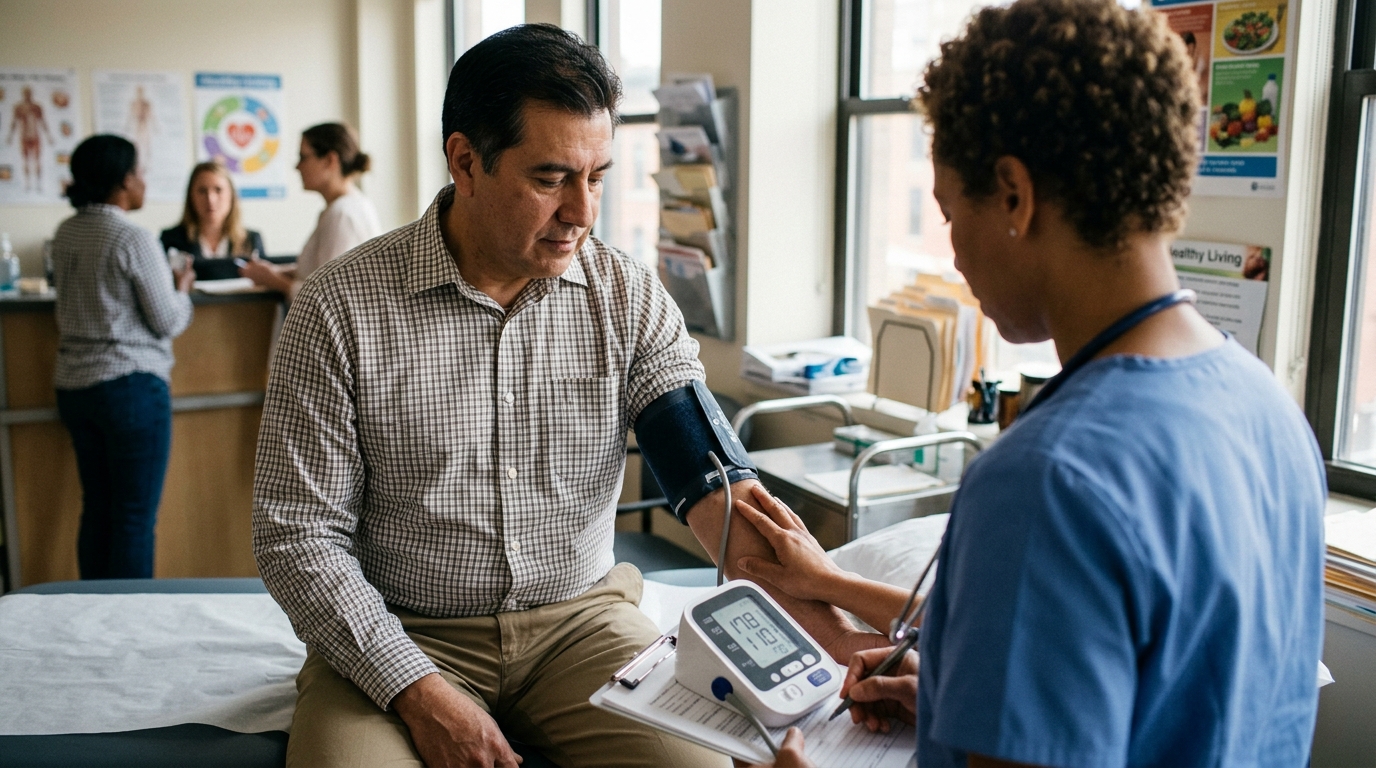
A single high reading at home is a prompt to check again, not a verdict. What turns a high number into an emergency is whether it comes with symptoms: the American Heart Association separates "severe hypertension" — call your healthcare professional — from "hypertensive emergency" — call 911 — at readings above 180 and/or above 120 mm Hg, with the symptom list deciding which one you are in (American Heart Association, undated).
A high home reading also has ordinary explanations: a cuff that is the wrong size or placed over clothing, talking or moving during the measurement, recent caffeine, pain, a full bladder, or anxiety about the reading itself. Those possibilities are reasons to measure again, not reasons to ignore a number that stays high.
Where to Go, Based on Your Symptoms
Venue
When it applies
Typical wait
What to expect once there
Call 911 (do not drive yourself)
Repeat reading of 180/120 mm Hg or higher plus chest pain, shortness of breath, back pain, numbness or weakness (often on one side), change in vision, or difficulty speaking (American Heart Association, undated). Also apply this if you are pregnant or recently gave birth and have a very high reading with headache or vision change, since severe preeclampsia and eclampsia are treated as emergencies (Cleveland Clinic, undated).
Treatment starts in the ambulance; you are assessed ahead of lower-risk arrivals
Blood pressure in both arms, ECG, blood and urine tests, sometimes brain or chest imaging to look for new organ damage — the thing that separates an emergency from a very high number alone (PMC review, undated)
Emergency department (walk-in)
Same symptom list as above if you are already near a hospital, or new confusion, severe headache, nausea, or passing much less urine than usual with a very high reading (PMC systematic review, undated)
Triaged on arrival; symptom-based, not arrival-order
The same work-up; expect several hours, as emergency treatment lowers pressure gradually over hours to days rather than all at once (PMC, undated)
Urgent care
Second reading, taken after five minutes of sitting quietly, still 180/120 mm Hg or higher with none of the listed symptoms, and your own office is closed or booked today (HealthCentral, undated)
Usually shorter than an ER, varies by site and hour
Repeat measurement with a properly sized cuff, questions about missed medication doses, and a decision about whether you need same-day ER transfer
Primary care office
Readings of 140/90 mm Hg or higher on most days, or 130–139 over 80–89, with no symptoms — stage 2 and stage 1 under the ACC/AHA categories (PMC, undated). Also for a new reading above 180/120 with no symptoms: ask for a same-day or next-day appointment. If that window passes without contact, call again the next morning rather than waiting for a routine slot, because organ damage can develop without obvious symptoms
Same-day or next-day at many practices; otherwise days
Review of your home log, repeat measurement, blood and urine tests, and discussion of medication and lifestyle changes (American Heart Association, undated)
Telehealth
Readings consistently at or above 130/80 with no symptoms, cuff technique questions, or follow-up after a change in your plan
Often same day
Guidance on how to measure, which readings to log, and whether to come in person or go to urgent care
How to Decide in the Moment
Sit down, feet flat, arm supported at heart level. Do not re-measure immediately — the AHA advises waiting a minute and repeating, and separate AHA home-monitoring guidance suggests waiting five minutes before the second reading (American Heart Association, undated; HealthCentral, undated).
Take the second reading. If it has dropped below 180/120, you are not in the emergency category on the number alone.
If it is still 180/120 or higher, run the symptom list out loud: chest pain, shortness of breath, back pain, numbness or weakness, change in vision, difficulty speaking (American Heart Association, undated). Add severe headache, confusion, nausea, or much less urine than usual (PMC systematic review, undated).
Any one of those present → call 911 now. Do not drive yourself and do not take an extra dose of anything to bring the number down.
None present → call your primary care office today, or its after-hours line. If no one can see or advise you today, go to urgent care.
If the repeat reading is high but below 180/120 and you have no symptoms, write down both numbers, the time and the arm used, and book a routine visit.
What to Say When You Call or Arrive
Lead with the numbers and the clock. Describe what you feel, not what you think it is.
Calling 911
Say this
"My home blood pressure monitor read 190 over 125, twice, five minutes apart. About twenty minutes ago my left arm went numb and I'm having trouble getting words out. I'm 58, I take blood pressure medication, and I'm alone at the front door. My address is..."
Calling your primary care office
Say this
"I need a same-day call back. I measured 185 over 122 at 8 this morning, waited five minutes, and got 183 over 120 on the second reading. No chest pain, no vision changes, no weakness. My readings have been in the 150s over 90s for about three weeks."
At urgent care reception or triage
Say this
"My repeat home reading is above 180 over 120 and has been for two days. I don't have chest pain, shortness of breath or trouble speaking. Here's my log — the readings, the times, and the cuff I used. I missed two days of my medication last week."
Three details move you up a triage list: when it started, whether it has changed since it started, and whether any of the listed symptoms are present now. Say "it started at 6 a.m. and the numbness hasn't gone away" rather than "it's been bad all morning."
Frequently asked questions
Will urgent care turn me away for a reading above 180/120?
Most urgent care clinics will measure you again, ask about missed doses and look for signs of organ strain, and they are an appropriate venue when you have no symptoms from the AHA list. If a symptom is present, they will usually call EMS and transfer you, which adds time — so with chest pain, vision change, one-sided weakness or trouble speaking, go straight to 911 or an ER. Policies and on-site testing vary by clinic and by state.
An ER visit is expensive. Is it worth going for a number alone?
Cost varies widely by plan, hospital and whether you are admitted, and an asymptomatic high reading is usually handled outside the ER — the AHA's own chart directs those readings to your healthcare professional rather than to 911 (American Heart Association, undated). What changes the calculation is a symptom alongside the number, because that is what marks possible organ damage. If you are weighing cost while a listed symptom is present, call 911 anyway and sort out billing later.
Is a high reading at home always hypertension?
No. A wrong cuff size, measuring over clothing, talking during the reading, recent caffeine, pain or a full bladder can all push a reading up, and a single high number is not a diagnosis. Diagnosis rests on repeated readings over time, taken correctly, and your clinician interpreting them alongside your history. This guide does not replace an in-person evaluation by a clinician.
Marguerite sets the tone for Wellnesslantern, chasing stories where everyday habits meet hard questions about long-term health. She's drawn to nuance over trends, and prefers a well-placed caveat to a bold claim. Readers know her for asking 'compared to what?' in every draft.