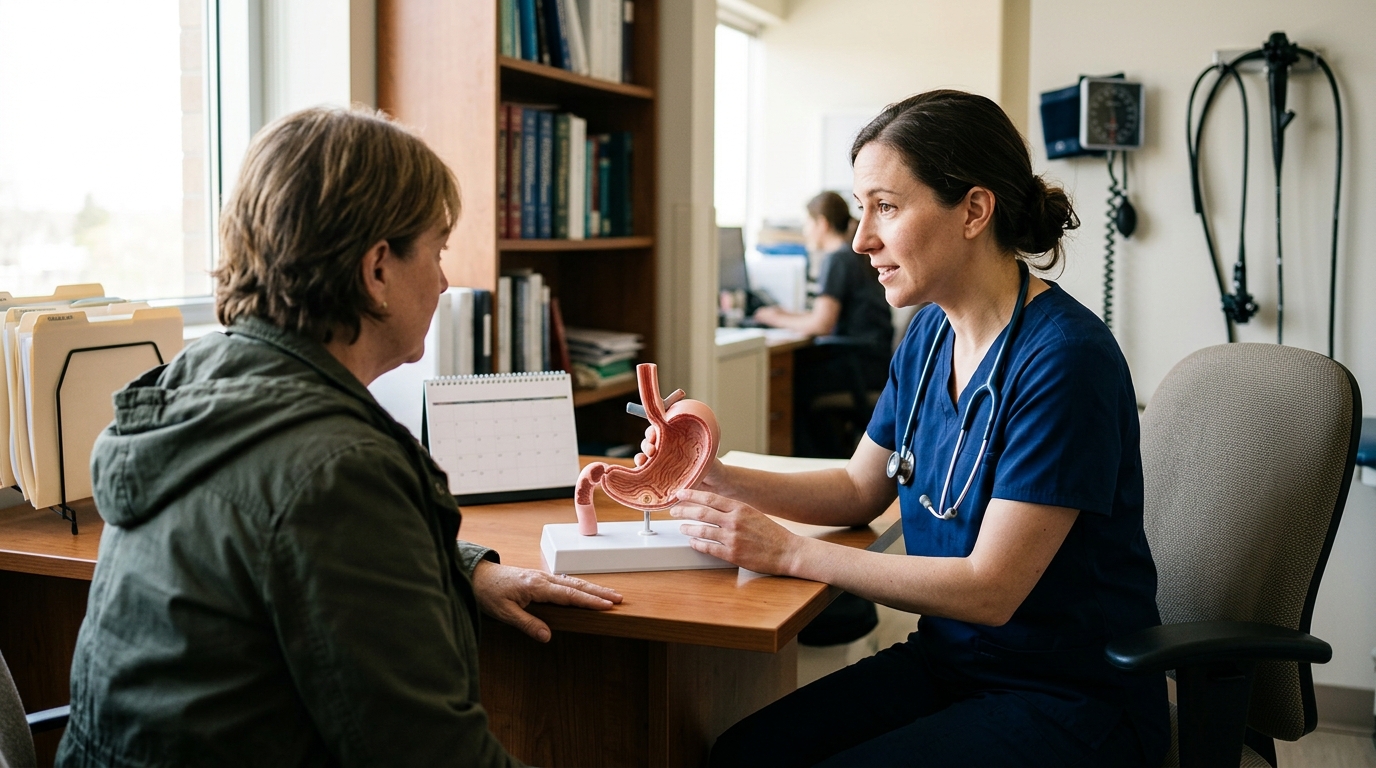
Reflux that keeps coming back has a name, a known set of triggers, and a short list of warning signs that change what your doctor does next.
GERD is the medical label for stomach contents coming back up into the swallowing tube often enough to bother you or to damage the tissue there. It is common, it is usually manageable, and the plan for it varies a lot from person to person.
This guide explains the words on your visit summary, lists the risk factors with a documented basis, and gives you a short list of things you can do on your own before your next appointment.
What GERD Means
GERD stands for gastroesophageal reflux disease. The esophagus is the muscular tube that carries food from your throat to your stomach, and reflux means stomach contents travelling back up it. The NIDDK describes gastroesophageal reflux (GER) as stomach contents coming back up into the esophagus, something many people have once in a while and often without symptoms.
GERD is the longer-lasting version. The NIDDK describes it as a more severe and long-lasting condition in which reflux causes repeated bothersome symptoms or leads to complications over time. MedlinePlus notes that reflux happening two or more times a week, or causing damage to the lining of the esophagus, may be GERD rather than occasional reflux. The NIDDK says researchers estimate about 20 percent of people in the United States have GERD.
The part that is not working as it should is usually the lower esophageal sphincter, a ring of muscle at the bottom of the esophagus that normally stays shut between swallows. The NIDDK says GERD may develop when that muscle becomes weak or relaxes when it shouldn't, letting acid and food move upward.
The usual symptoms, per the NIDDK, are heartburn, a painful burning feeling in the middle of the chest, and regurgitation, meaning stomach contents coming up into the throat or mouth. Not everyone has those. Some adults instead have chest pain, nausea, pain or trouble swallowing, or signs of complications such as a long-running cough or hoarseness.
How GERD goes varies by person. It can settle with changes you and your doctor make, and it can also persist or come back; the NIDDK says doctors may recommend lifestyle changes, medicines, surgery, or a combination.
Common Causes and Risk Factors
These are listed without ranking, because the sources do not rank them. Having one does not mean it caused your GERD.
- Extra body weight — often changeable. The NIDDK lists being overweight or having obesity among factors that may affect the lower esophageal sphincter, and a StatPearls review lists excessive body mass index (BMI) as a risk factor.
- Smoking or inhaling secondhand smoke — often changeable. Named by both the NIDDK and the StatPearls review.
- Pregnancy — temporary, not a choice. The NIDDK lists it among factors that can affect the sphincter.
- Older age — not changeable. Listed as a risk factor in the StatPearls review.
- A hiatal hernia — not changeable on your own. This is when the opening in the diaphragm, the breathing muscle under your lungs, lets the upper part of the stomach move into the chest; the NIDDK says it can increase the chance of GERD or worsen symptoms.
- Certain medicines — sometimes adjustable, but only with your doctor. The NIDDK names benzodiazepines, calcium channel blockers, certain asthma medicines, NSAIDs (nonsteroidal anti-inflammatory drugs such as ibuprofen, sold as Advil), and tricyclic antidepressants as able to cause GERD or worsen symptoms.
- Certain foods and drinks — often changeable. The NIDDK commonly links acidic foods such as citrus fruits and tomatoes, alcoholic drinks, chocolate, coffee and other caffeine, high-fat foods, mint, and spicy foods to symptoms.
- Anxiety or depression, and less physical activity at work — partly changeable. Both appear as risk factors in the StatPearls review.
Frequently asked questions
Is GERD serious?
For many people it is a long-running nuisance that responds to treatment, but ongoing acid exposure can cause problems. A StatPearls review notes that chronic inflammation of the esophagus can lead to scarring and peptic strictures — narrowed segments that usually show up as dysphagia, meaning difficulty swallowing. Food sticking when you swallow, vomit that looks like coffee grounds, or black, tarry stool are reasons to contact a doctor the same day rather than waiting for your next visit.
Will I need an endoscopy?
Not everyone does. The NIDDK says doctors diagnose reflux by reviewing symptoms and medical history, and that tests may be needed if symptoms don't improve with lifestyle changes and medicines. The 2022 American College of Gastroenterology guideline recommends an 8-week trial of an empiric proton pump inhibitor for people with classic heartburn and regurgitation who have no alarm symptoms; your doctor decides whether that fits you.
Can GERD be cured, or do I have it for life?
The course varies and no one can promise you a timeline. The NIDDK says people may manage symptoms with lifestyle changes or over-the-counter medicines, and that doctors may recommend lifestyle changes, medicines, surgery, or a combination. The 2022 American College of Gastroenterology guideline lists antireflux surgery by an experienced surgeon as a long-term option for people with objective evidence of GERD, particularly severe esophagitis, large hiatal hernias, or persistent troublesome symptoms.
How do I tell heartburn from a heart problem?
You often cannot tell them apart from the feeling alone, which is why chest pain is on the NIDDK's list of symptoms to see a doctor about. Treat chest pain that is severe, crushing, or comes with shortness of breath, sweating, or pain spreading to the arm or jaw as an emergency and call 911. If your reflux symptoms do not get better with over-the-counter medicines or lifestyle changes, the NIDDK says to see a doctor.
Do I need to give up coffee and spicy food?
The NIDDK lists coffee and other caffeine, spicy foods, citrus and tomatoes, alcohol, chocolate, mint, and high-fat foods as commonly linked to symptoms, but triggers differ from person to person. A food and symptom log is the practical way to find yours, and your doctor or a dietitian can help you read it. If you develop trouble swallowing or unexplained weight loss while adjusting your diet, contact your doctor promptly.