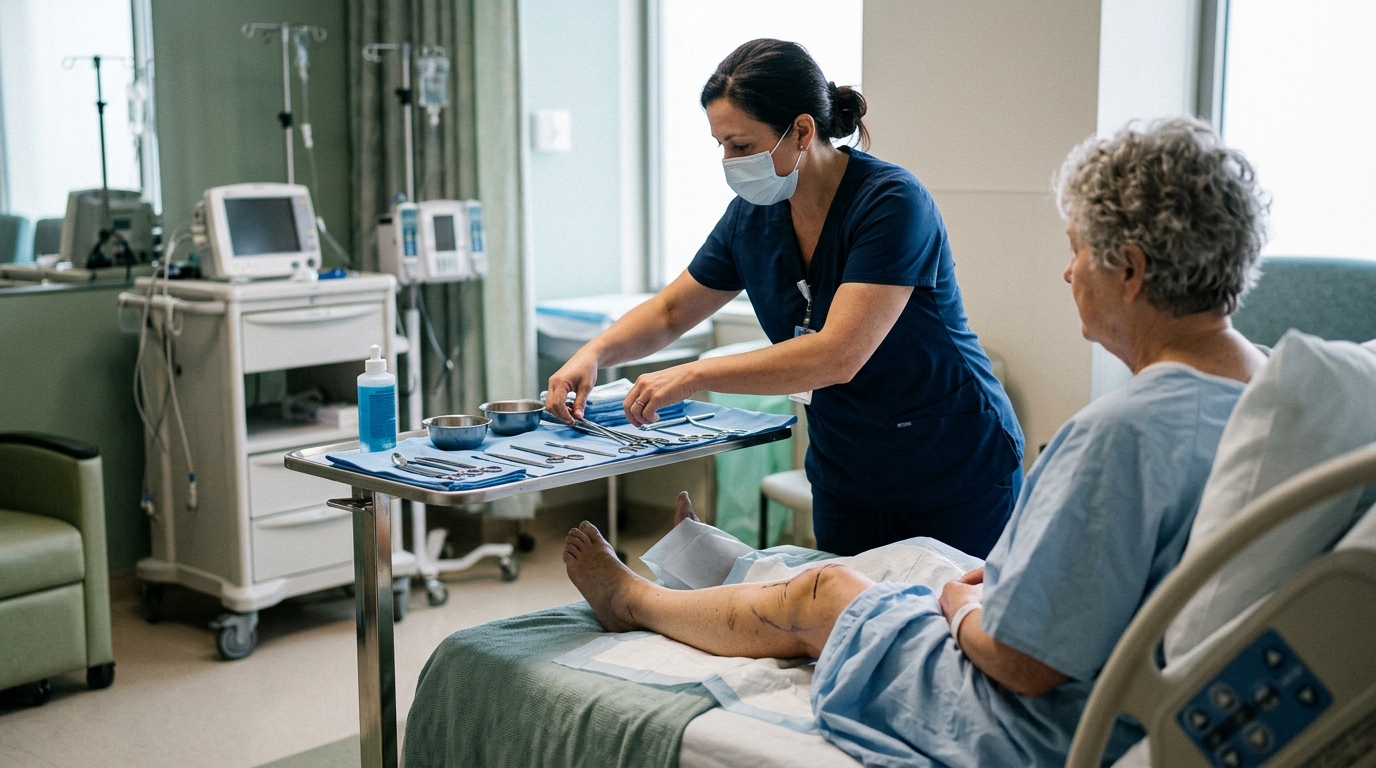
Before Your Knee Replacement: A Preparation Checklist
By Desmond Vance|Updated Oct 06, 2026|9 min read
The weeks before a knee operation carry more homework than the day itself: dental work finished, medication holds confirmed, grab bars up, a ride booked.
Most of the preparation for a total knee replacement (knee joint surgery) happens in the four to six weeks before you arrive — a medical clearance visit, decisions about which medications to pause, finishing dental work, and making your home safe to move around in with a walker.
The specifics below are general rules. Exact hold times, fasting cutoffs and arrival times differ by hospital, by surgeon and by your own health conditions, so confirm every number here against the written instructions your surgical team gives you.
Preparation Timeline
Dates shift between facilities. Use this as the shape of the plan, then write your own version from the instruction sheet your surgeon's office gives you.
Several weeks before — Schedule a complete physical examination with your primary care doctor to confirm you are healthy enough for the operation and the recovery (American Academy of Orthopaedic Surgeons OrthoInfo, undated). The general rule: chronic conditions such as diabetes, heart disease and high blood pressure should be assessed and stable before you go under anesthesia.
Several weeks before — Complete any major dental procedures, such as tooth extractions or periodontal work (American Academy of Orthopaedic Surgeons OrthoInfo, undated). The rule behind it is infection risk: bacteria released during dental work can travel to a newly implanted joint.
One to two weeks before — Your doctor may stop certain medications or supplements, or substitute others until surgery (American Academy of Orthopaedic Surgeons OrthoInfo, undated). If you take a platelet inhibitor such as clopidogrel (Plavix), it is stopped a set number of days before surgery (NYU Langone Health, undated), and that number comes from the prescriber, not from a general article.
7 days before — Stop all NSAIDs — naproxen (Aleve), ibuprofen (Advil, Motrin) and aspirin — and most supplements, including vitamin E, ginkgo biloba, ginseng, glucosamine and fish oil (UCSF Health, undated). These affect bleeding and clotting. Acetaminophen (Tylenol) and celecoxib (Celebrex) are generally fine up to the day of surgery (UCSF Health, undated); dosing and timing are physician-directed.
7 days before — Install safety bars or a secure handrail in your shower or bath and secure the handrails along your stairways (American Academy of Orthopaedic Surgeons OrthoInfo, undated). Clear rugs and cords from the paths you will walk with a walker.
48 hours before — No alcohol at all (American Academy of Orthopaedic Surgeons OrthoInfo, undated).
The night before — Stop eating after midnight (Johns Hopkins Medicine, undated; Newton-Wellesley Hospital, undated). Clear liquids such as water, black coffee, clear tea, apple juice and cranberry juice are usually allowed until a stated cutoff time before surgery (Newton-Wellesley Hospital, undated) — ask for that exact clock time, because anesthesiology guidance discourages fasting longer than needed (American Society of Anesthesiologists guidance, described in Cureus, 2017).
Morning of — Shower if instructed, take only the medications your surgical team approved with the smallest sip of water allowed, and leave for the hospital in time for the arrival time on your paperwork.
Preparation Checklist
Book the pre-operative physical examination with your primary care doctor and make sure the report reaches your surgeon's office.
Schedule and complete extractions or periodontal treatment before the surgery date.
Give your orthopaedic surgeon a complete list of everything you take, including over-the-counter drugs, herbs and vitamins; the surgeon specifies which to stop and which to continue (American Academy of Orthopaedic Surgeons OrthoInfo, undated).
Confirm every medication-hold instruction with the physician who prescribed it. Protocols vary by facility and by drug, and you are told to always discuss the timing of stopping blood thinners or platelet inhibitors with the prescribing doctor so the plan is individualized (NYU Langone Health, undated).
Stop NSAIDs and the listed supplements seven days before.
Stop alcohol 48 hours before.
Write down the exact fasting cutoff and the clear-liquid cutoff your facility gives you, in clock times.
Arrange a driver and, if you are discharged the same day, an adult who can stay with you overnight.
Install grab bars and handrails; move what you use daily to waist height.
Call your insurance provider with any questions about coverage (Allina Health, undated) — hospital staff cannot confirm your benefits for you.
Fill any prescriptions your surgeon sends ahead of the date so you are not driving to a pharmacy afterwards.
What to Bring and What to Avoid
Bring to the hospital
Item
Why it is asked for
Legal photo identification
Identity check at registration (Hospital for Special Surgery, undated)
Hospitalization insurance card
Registration (Hospital for Special Surgery, undated)
Up-to-date list of medications and doses, including over-the-counter drugs, herbs and vitamins
Medication reconciliation (American Academy of Orthopaedic Surgeons OrthoInfo, undated)
List of drug and food allergies
Safety check before anesthesia (American Academy of Orthopaedic Surgeons OrthoInfo, undated)
Health care proxy, medical power of attorney and/or living will
Placed in your chart (American Academy of Orthopaedic Surgeons OrthoInfo; Hospital for Special Surgery, undated)
Any assistive device you already use
Fitting and discharge planning (Hospital for Special Surgery, undated)
Loose clothing, flat non-slip shoes, glasses and hearing aid cases
Walking on day one
Leave at home
Valuables, large amounts of money and jewelry, including your wedding ring (Allina Health, undated).
Your own medicines, including pills and inhalers, unless your team specifically asked for them (Allina Health, undated).
Avoid before surgery
Eating after midnight the night before, and drinking anything other than approved clear liquids after your stated cutoff.
Alcohol within 48 hours of surgery.
NSAIDs and most supplements within seven days of surgery.
Driving yourself to the hospital.
Costs and what your plan pays are a separate question from any of this — confirm coverage, pre-authorization and out-of-network details directly with your insurer.
Day-of Instructions
Wake early enough to not rush. Do not eat. Take only sips of water with approved medications if your team allowed it (UCLA Health, undated).
Shower with the soap or wipes you were given, if your facility provided a skin-prep product. Skip lotion, deodorant, makeup and nail polish unless told otherwise.
Dress in loose clothing that fits over a bandaged knee, and leave jewelry at home.
Take your bring list: ID, insurance card, medication and allergy lists, proxy documents, assistive device.
Travel with your driver. Knee replacement is performed under general anesthesia or under spinal or epidural regional anesthesia, often with moderate (conscious) sedation; your anesthesiology team will tell you which is planned for you. With any of these, you may not drive yourself home, and a responsible adult must accompany you and stay with you if you are discharged the same day.
Arrive at the clock time on your paperwork — adult surgical patients are normally asked to arrive before the surgery start time (Johns Hopkins Medicine, Department of Anesthesiology and Critical Care Medicine, undated) to allow for registration, marking the correct knee and the anesthesiology interview. Ask your facility for your exact arrival time; it is not the same as the incision time.
At check-in, say out loud when you last ate, when you last drank, and the last date you took any blood thinner or NSAID.
Routine and expected on the day: nerves, a dry mouth from fasting, a long wait between arrival and being taken back, repeated questions about which knee, and mild soreness at an IV site.
Call your surgeon's office before you leave home if you have a fever, a cough, vomiting or diarrhea, a new rash, or any break or infection in the skin near the knee — these can change whether surgery goes ahead that day.
Call 911 or go to the emergency room for chest pain, sudden shortness of breath, fainting, or new pain and swelling in a calf. Those are not pre-operative jitters, before or after the operation.
Recovery length is tied to this specific operation and to you: ask your surgeon for your expected range in weeks for walker and cane use, and in months for return to driving, work and stairs. Those ranges differ by age, by other conditions, and by whether you are having a partial or total knee replacement — get yours in writing from your own care team.
Frequently asked questions
I forgot and ate something after midnight. Do I just not mention it?
Tell the hospital, and tell them before you leave home if possible. Fasting rules exist because food or liquid in the stomach is a risk during general anesthesia and sedation, and the team needs the real time and the real food to decide whether to delay your start time or reschedule. Hiding it does not make the risk go away. Facilities differ in how they handle it, which is why the call matters more than the guess.
I take a blood pressure or diabetes medication every morning. Do I take it on surgery day?
Some daily medications are continued with a sip of water on the morning of surgery and some are held, and the split is specific to the drug and to you. Your surgeon tells you which medications to stop and which to continue (American Academy of Orthopaedic Surgeons OrthoInfo, undated), and for blood thinners and platelet inhibitors you are told to settle the timing with the doctor who prescribed them (NYU Langone Health, undated). Ask for that list in writing at your pre-operative visit, and read it back to confirm.
I took ibuprofen four days before my date. Does that cancel the surgery?
Not necessarily, but it is information your surgeon needs rather than something to let slide. NSAIDs such as ibuprofen (Advil, Motrin) and naproxen (Aleve) are generally stopped seven days before knee replacement (UCSF Health, undated) because of their effect on bleeding. Call the office, say what you took and when, and let them decide whether anything changes.
Who has to come with me, and for how long?
Plan for an adult who can drive you to the hospital, and — if your surgery is done as a same-day procedure — bring you home and stay with you overnight, because general anesthesia, spinal anesthesia and moderate sedation all rule out driving yourself. Even for an inpatient stay, someone should know your discharge date and be reachable. Confirm your facility's escort policy when you book; some will not proceed without a named adult on file.
Desmond writes about sleep, stress, and the slow erosion of both in modern life. He's most interested in the gap between what people know they should do and what actually gets them to do it.