Wellness Lantern

Cortisone Shot vs. Physical Therapy: Which Is Right for You?

One is a needle in a clinic room that takes minutes; the other is a course of appointments you work through — here is how the two compare before you book.

Table of contents
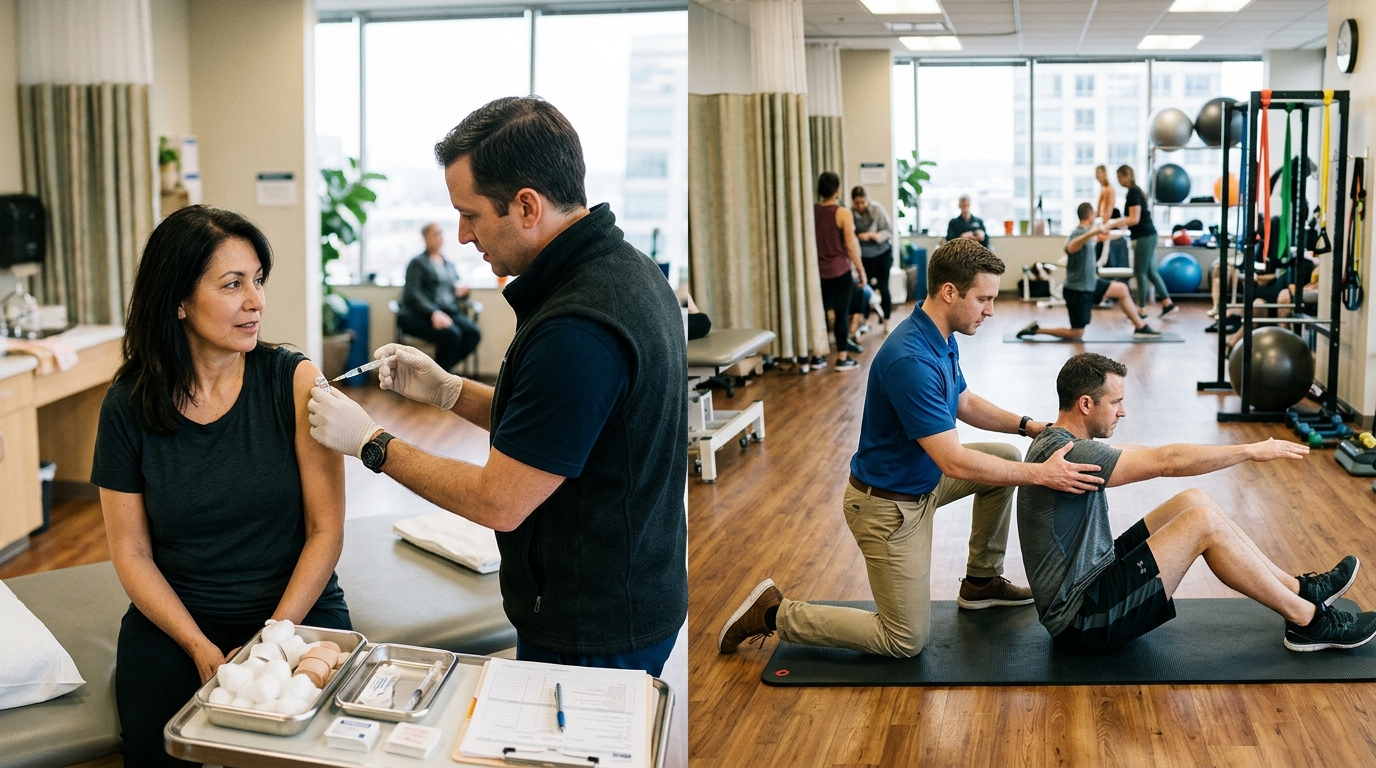
Featured image for "Cortisone Shot vs. Physical Therapy: Which Is Right for You?"

A cortisone shot (corticosteroid injection) and physical therapy (PT, supervised exercise and hands-on treatment) are often offered for the same joint problem, but they are not the same kind of decision. The injection is a brief needle procedure done with numbing medicine and aimed at calming inflammation now; physical therapy is a series of visits aimed at changing how the joint is loaded and supported over weeks. Many people end up doing both, in an order their clinician chooses.

This guide compares the two on invasiveness, numbing, how long each takes, and what the days afterward look like — plus what counts as an expected after-effect and what means you should call. Which option suits you depends on your age, the specific joint and tissue involved, other conditions such as diabetes, any surgery you may be planning, and the guideline edition your clinician follows. Confirm every protocol below with your own care team, because instructions differ by facility and physician.

How the Two Procedures Differ

Invasiveness. A cortisone shot (corticosteroid injection) breaks the skin: a provider inserts a needle into the treated area and injects the steroid, sometimes using ultrasound to guide it (Cleveland Clinic, undated). Physical therapy (PT) is non-invasive — nothing enters the body; it is exercise, manual therapy, education, and a home programme (MD Bone & Joint, undated).

Anesthesia type. The injection uses local anesthetic only — a numbing medicine such as lidocaine (Xylocaine) or bupivacaine (Marcaine) mixed with the steroid for faster relief, since the steroid itself takes a few days to start working (AAOS/OrthoInfo, 2024-07). Some teams also spray a skin-numbing medicine at the site (Mayo Clinic, undated). No moderate (conscious) sedation and no general anesthesia are used for a standard joint injection. Physical therapy uses no anesthesia at all — not local, not sedation, not general.

Typical duration. The whole injection process is quick, and the overall clinic visit is brief, including the history and medication review beforehand (Mountain Spine Orthopedics, undated; Knee Pain Centers of America, undated). Physical therapy is the opposite shape: a longer first visit for an in-depth evaluation of health, mobility, strength, and lifestyle (PTSMC, undated), then repeat appointments over weeks.

Typical recovery length. After an injection, most clinicians advise relative rest and avoiding strenuous activity on the joint, after which normal activity is generally permitted (Gale, undated); pain may briefly worsen for 1 to 2 days first (AAOS/OrthoInfo, 2024-07). Physical therapy has no recovery period in the procedural sense — there is nothing to heal from — but soreness after sessions is common and progress is measured in weeks of the plan built at your evaluation.

Candidacy. Shots are limited: providers often set a practical yearly cap (AAOS/OrthoInfo, 2024-07; Cleveland Clinic, undated), they are generally avoided for tendinitis because of rupture risk in the biceps, patellar, or Achilles tendons (AAOS/OrthoInfo, 2024-07), and a shot into a joint means replacement surgery in that joint should be delayed to lower infection risk (AAOS/OrthoInfo, 2024-07). Ask your surgeon before accepting an injection if a joint replacement is on your horizon. Do not ask us to price either option — confirm cost and coverage with your provider's billing office and your insurer.

What Each Procedure Involves

Cortisone shot (corticosteroid injection)

  • Your provider reviews your medical history and medications and may ask you to stop certain blood thinners; raise this at least 7 days before the appointment so your prescriber has time to name an exact stop date (Knee Pain Centers of America, undated).
  • The skin is cleaned with antiseptic (Knee Pain Centers of America, undated).
  • Numbing: a local anesthetic such as lidocaine or bupivacaine is used, often mixed with the steroid (AAOS/OrthoInfo, 2024-07); the team may also spray a numbing medicine on the skin (Mayo Clinic, undated). Steroid choice, dose, and timing are physician-directed.
  • The needle goes into the treated area and the steroid is injected. Ultrasound or fluoroscopy (a type of X-ray) may be used to watch the needle's progress (Cleveland Clinic, undated; Mayo Clinic, undated). You will feel pressure and brief stinging, as described in the consent discussion.
  • Afterward, most people walk immediately and drive themselves home (Mountain Spine Orthopedics, undated). If you have diabetes, check your blood sugar more often starting the day of the injection, because of a temporary rise (Cleveland Clinic, undated); ask exactly how many days to keep checking.

Physical therapy (supervised exercise and manual treatment)

  • Numbing: none. No local anesthetic, no moderate (conscious) sedation, no general anesthesia at any point.
  • First visit: an in-depth evaluation of your health, mobility, strength, and lifestyle, used to build a personalised plan (PTSMC, undated), including range of motion, strength, flexibility, and balance testing (MD Bone & Joint, undated).
  • Following visits combine exercises, manual (hands-on) therapy, education about the condition, and home care between appointments (MD Bone & Joint, undated).
  • Arrive 15 minutes before your first appointment to finish intake paperwork, and bring a list of your current medications.
  • Your therapist reassesses and adjusts the plan as you go. Ask at visit one how many weeks the plan is written for.

Recovery Comparison

MilestoneCortisone shotPhysical therapy
Return to workSame day — the visit is brief and most people leave walking (Mountain Spine Orthopedics, undated)Same day — each session is an outpatient appointment
Return to drivingSame day; most patients drive themselves home (Mountain Spine Orthopedics, undated)Same day, before and after every session
Return to strenuous use of the jointAfter 1 to 2 days of relative rest while any flare settles, then normal activity is generally permitted (AAOS/OrthoInfo, 2024-07; Gale, undated)Graded over the weeks of your plan, starting from the first session
First noticeable pain changeMinutes, from the local anesthetic; a few days for the steroid itself (AAOS/OrthoInfo, 2024-07)Across the first few sessions, within the week-by-week plan set at evaluation (PTSMC, undated)
Full benefit / course lengthRelief can last several weeks (AAOS/OrthoInfo, 2024-07); repeat shots require a waiting interval and a yearly limit (Cleveland Clinic, undated)Weeks to months of appointments, with the number set at your first evaluation (MD Bone & Joint, undated)

Routine and expected after a cortisone shot: a flare of worse pain or swelling for 1 to 2 days before the steroid takes effect (AAOS/OrthoInfo, 2024-07; Mountain Spine Orthopedics, undated); a numb area that wears off; a short-lived blood sugar rise if you have diabetes (Cleveland Clinic, undated).

Routine and expected after physical therapy: muscle soreness after new exercises; fatigue; a temporary increase in stiffness that eases.

Call your care team (not routine): pain and inflammation that are still there after the number of days your provider named following the shot (Cleveland Clinic, undated); pain that worsens session after session in therapy; any new weakness.

Go to the ER or call 911: a hot, red, swollen joint with fever and chills, or spreading redness at the injection site — possible joint infection; a sudden pop with inability to bear weight or move the limb — possible tendon rupture; sudden chest pain, trouble breathing, or facial swelling and hives after the injection. These are different from the expected 1-to-2-day flare.

Questions to Ask Your Doctor

Take these to the appointment and ask them aloud. Confirm the answers with your own care team, since protocols differ by facility and physician.

  • "Is my problem inside the joint, or is it tendinitis? If it's tendinitis, does the tendon rupture risk rule out a cortisone shot for me?"
  • "Am I likely to need joint replacement in this joint, and how long would a shot delay that surgery?"
  • "Will you use ultrasound or fluoroscopy to guide the needle, and does that change the chance the injection misses the joint space?"
  • "What local anesthetic will you mix with the steroid, and how long will the numbness last?"
  • "How many of these shots can I have in a year, and how long must I wait between rounds?"
  • "Exactly how many days after the shot should I call if the pain hasn't improved?"
  • "Which of my blood thinners do I stop, and on which date?"
  • "I have diabetes — how many days should I check my blood sugar more often afterward?"
  • "How many days of relative rest before I lift, run, or go back to my usual job tasks?"
  • "If we start physical therapy instead, how many weeks is the plan, and how will we know it's working?"
  • "Can I do both — and if so, which comes first, and how long after the shot does therapy start?"
  • "Who do I call after hours, and which symptoms mean the ER instead of a phone call?"
  • "Who do I speak to at your office about cost and coverage for each option?"

Frequently asked questions

My pain got worse the day after the shot. Did it fail?

A temporary flare of increased pain or swelling in the first 1 to 2 days before the steroid takes effect is a recognised after-effect (American Academy of Orthopaedic Surgeons (OrthoInfo), 2024-07; Mountain Spine Orthopedics, undated). The steroid itself takes a few days to start working, which is why a local anesthetic is usually mixed in for earlier relief (AAOS/OrthoInfo, 2024-07). What is not a flare is a hot, swollen joint with fever and chills — that needs emergency assessment. Ask your provider at the visit exactly how many days to wait before calling (Cleveland Clinic, undated).

Can I have physical therapy and a cortisone shot at the same time?

They are not mutually exclusive, and clinicians often sequence them — the injection to quiet inflammation, therapy to build strength and movement around the joint (MD Bone & Joint, undated). The order and spacing are a clinical judgement that depends on your joint, your diagnosis, and any surgery you may be planning. Ask your physician and therapist to agree on the plan rather than deciding on your own.

Why do shots have a yearly limit when physical therapy doesn't?

Providers often set a practical cap on how many cortisone shots are given per year, and a waiting interval between rounds (American Academy of Orthopaedic Surgeons (OrthoInfo), 2024-07; Cleveland Clinic, undated). Physical therapy has no equivalent cap because nothing is injected; the limit there is the length of the plan written at your evaluation. If you have already used your shots for the year, that is a specific thing to raise when discussing next steps.

What if the injection gives me no relief at all?

Depending on the practitioner's skill and where the injection is placed, it can miss the joint space and give little or no relief, and ultrasound guidance can help reduce that risk (American Academy of Orthopaedic Surgeons (OrthoInfo), 2024-07). It is also true that how long a shot takes to work varies from person to person (Cleveland Clinic, undated). Call your provider at the day mark they gave you rather than assuming the diagnosis was wrong.

Sources

  1. American Academy of Orthopaedic Surgeons (OrthoInfo)Cortisone Shot (Steroid Injection) - OrthoInfo - AAOS2024-07
  2. Cleveland ClinicCortisone Shots (Steroid Injections): Benefits & Side Effects

Written by

Desmond Vance

Desmond writes about sleep, stress, and the slow erosion of both in modern life. He's most interested in the gap between what people know they should do and what actually gets them to do it.