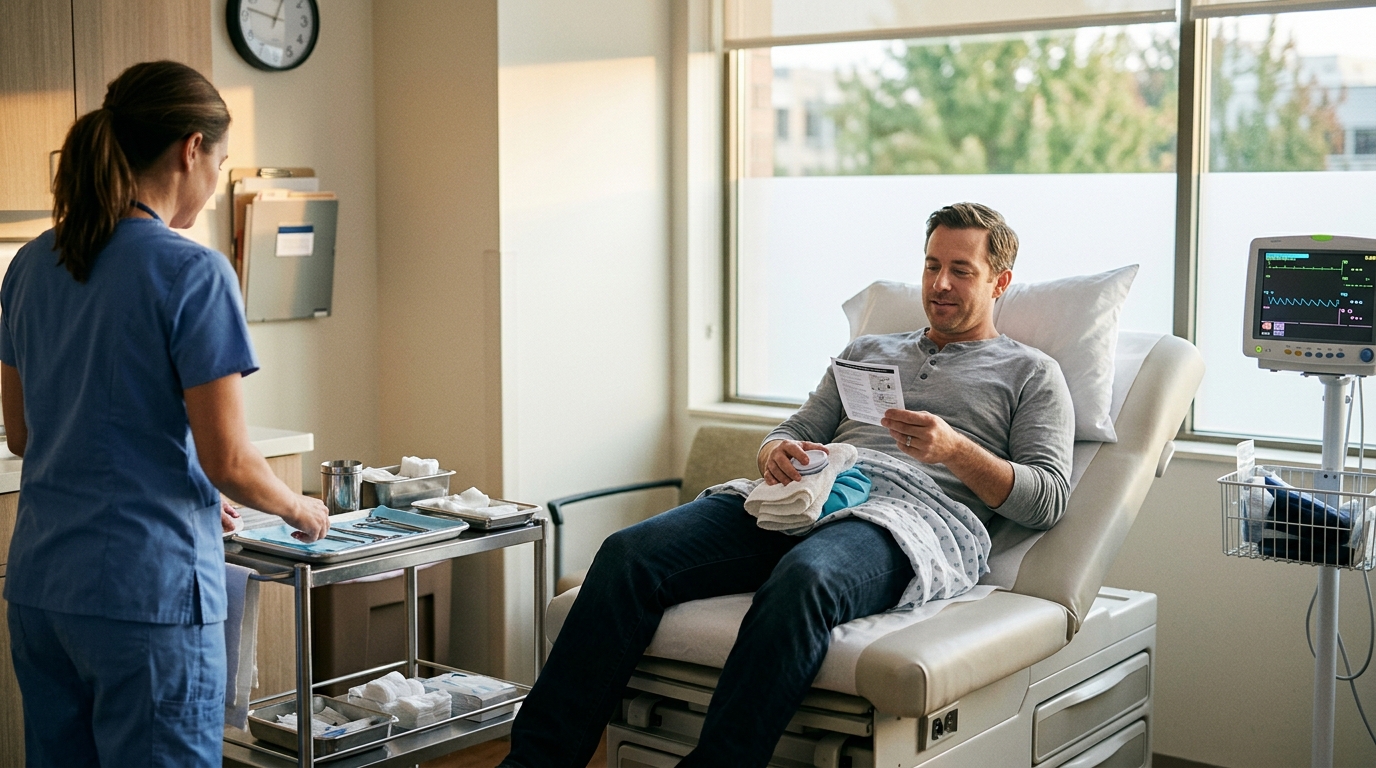
A vasectomy (male sterilization surgery) is a short outpatient procedure — a standard or no-scalpel vasectomy may take 15–30 minutes (Urology Care Foundation, 2025-11) — but recovery happens in two separate tracks. The scrotal soreness track is short: most men have discomfort, bruising and some swelling that usually go away within 2 weeks (NICHD, 2022-02-18). The contraception track is longer: it takes about 20–30 ejaculations or about three months to clear sperm from the tubes, and results vary by individual (Urology Care Foundation, 2025-11).
Timelines shift with your age, your job, whether you have a bleeding disorder or take blood thinners, and which guideline edition your surgeon follows. Your own discharge sheet always outranks a general guide like this one.
Immediately After the Procedure
Most vasectomies are done with local anesthetic injected into the scrotal skin and around the vas deferens, so you are awake and go home the same day. Some men are offered oral or intravenous moderate (conscious) sedation, and a small number have the procedure under general anesthesia for medical or anatomical reasons.
After the surgeon finishes, staff usually keep you in the room or a recovery area for a short observation period — often 15–30 minutes — checking the dressing for bleeding and making sure you are not lightheaded when you stand. Typical discharge criteria are: stable vital signs, a dry dressing, the ability to walk unassisted, and the ability to urinate. A scrotal support or snug underwear is usually applied before you leave.
If you had any sedation or general anesthesia, you may not drive yourself home. A responsible adult must drive you and, at many facilities, stay with you for the rest of the day. With local anesthetic only, some practices allow you to drive yourself and others do not — ask when you book, not on the morning of the procedure.
The scrotum and testicles will be numb for a few hours after a vasectomy (Urology Care Foundation, 2025-11), so soreness tends to arrive later that day as the numbing wears off. At home, you may apply cold packs and should lie on your back as much as possible for the rest of the day (Urology Care Foundation, 2025-11). If a pain reliever is advised, it is commonly an over-the-counter option such as acetaminophen (Tylenol); choice, dose and timing are physician-directed, and some surgeons give specific instructions about anti-inflammatories around surgery.
Recovery Timeline
First 24 hours
Rest on your back with cold packs as directed (Urology Care Foundation, 2025-11).
No work, no driving if you had sedation or general anesthesia, no exercise.
Showering, bathing and dressing changes follow your facility's own sheet — these rules vary widely.
Days 1–3
Expect swelling and minor pain in the scrotum for a few days (Urology Care Foundation, 2025-11), often with bruising that darkens before it fades.
Work: men doing deskwork may be able to go back in one or two days; men with active jobs or heavy lifting may need more time off (Urology Care Foundation, 2025-11).
Driving: usually reasonable once you are off any sedating medication and can brake sharply without guarding — confirm with your surgeon.
Exercise: walking only. No running, cycling, gym work or swimming.
Week 1
Soreness typically fades to an ache with movement. Keep wearing supportive underwear if advised.
Avoid heavy lifting for a week (Urology Care Foundation, 2025-11).
Sex: you can have sex as soon as you are comfortable, usually within a week (Urology Care Foundation, 2025-11) — but keep using other contraception.
Exercise: light cardio may be cleared toward the end of this week; your surgeon decides.
Weeks 2–4
Discomfort, bruising and swelling usually go away within 2 weeks (NICHD, 2022-02-18).
Most men are back to full work duties, driving and their usual gym routine in this window, resuming lifting and contact sport gradually and stopping if pain returns.
Weeks 8–12 and beyond
A post-vasectomy semen sample may be submitted as early as 8 weeks following vasectomy (AUA), and a doctor will most often test sperm count three months after the procedure (Urology Care Foundation, 2025-11).
Keep using other contraception until your own result is confirmed. Among 1,000 vasectomies, 11 will likely fail over 2 years, and half of those failures occur within the first 3 months (NICHD, 2022-02-18).
All of these intervals are general. Confirm your own return-to-work, driving and lifting dates with your surgeon's office.
Normal vs. Concerning Recovery Signs
Expected and routine
Call your care team
Call 911 or go to the ER
Numbness for a few hours after the procedure (Urology Care Foundation, 2025-11)
Fever, or scrotal redness and tenderness — signs of infection that need to be checked (NICHD, 2022-02-18)
Sudden severe scrotal pain with a rapidly enlarging scrotum, with or without feeling faint
Swelling and minor pain in the scrotum for a few days (Urology Care Foundation, 2025-11)
A lot of scrotal swelling soon after surgery (Urology Care Foundation, 2025-11)
Bleeding that soaks through a dressing or pad in an hour or less and does not stop with firm pressure
Bruising and discomfort that usually settle within 2 weeks (NICHD, 2022-02-18)
Painful swelling that may be a hematoma — bleeding under the skin (NICHD, 2022-02-18)
Fainting, chest pain or shortness of breath
Aching with lifting that eases over days
Inability to urinate, or pus or foul drainage from the incision
Confusion, or a fever with shaking chills and a hard, hot scrotum
A small firm lump — a granuloma from sperm leaking into surrounding tissue (NICHD, 2022-02-18)
Pain that is worsening rather than easing after the first few days
Surgeons who perform vasectomy should be able to recognize and treat complications including bleeding, infection, epididymitis and chronic scrotal pain (AUA), so your operating surgeon's office is the right first call for anything in the middle column. About one to two percent of men may have ongoing pain or discomfort after a vasectomy (Urology Care Foundation, 2025-11); raise it rather than waiting it out.
When to Call Your Doctor
Follow your own surgeon's or facility's discharge instructions above everything below — thresholds and contact numbers differ by practice, and yours were written for your anatomy and medical history.
Call the office if you have:
A temperature at or above 100.4°F (38°C), or any fever your discharge sheet names as a threshold (NICHD, 2022-02-18).
Scrotal redness, heat and tenderness that is spreading rather than fading (NICHD, 2022-02-18).
Scrotum that swells a lot soon after surgery (Urology Care Foundation, 2025-11), or painful swelling suggesting a hematoma (NICHD, 2022-02-18).
Pus, foul-smelling drainage or an incision that opens.
Pain still getting worse after day 3, or pain not controlled by the medication your surgeon directed.
Inability to pass urine for 8 hours or longer.
A new scrotal lump that grows or becomes painful.
Any persistent motile sperm at 6 months — counseling for repeat vasectomy should be offered (AUA).
Call 911 or go to the emergency department for bleeding that soaks a dressing or pad within an hour, or for sudden severe scrotal pain with rapid swelling and faintness. Do not wait for office hours.
Frequently asked questions
When can I drive again?
If you had oral or intravenous moderate (conscious) sedation or general anesthesia, someone else must drive you home and most facilities bar driving for the rest of that day. With local anesthetic alone, many practices allow driving the next day once you can press a brake pedal hard without guarding. Any prescription pain medication that makes you drowsy restarts the clock — ask your surgeon for their rule.
When can I shower?
Shower timing is one of the most practice-specific instructions there is: some surgeons allow a shower the next day, others ask you to keep the dressing dry for 48 hours. Soaking — baths, hot tubs, pools — is usually held longer because of infection risk. Use the timeframe printed on your own discharge sheet rather than a general rule.
When can I lift weights or go back to the gym?
You should avoid heavy lifting for a week after a vasectomy (Urology Care Foundation, 2025-11). Walking is usually fine from day one, with light cardio often cleared toward the end of week one and most men back to their full routine within 2 to 4 weeks as swelling resolves. Build back gradually and stop if the ache returns.
When can I stop using other birth control?
Not until a semen test confirms it. Patients may discontinue contraception following confirmation of complete azoospermia or ≤100,000 rare non-motile sperm per mL from a single uncentrifuged sample evaluated within 2 hours of collection (AUA); a doctor will most often test about three months after surgery (Urology Care Foundation, 2025-11). Remember that a vasectomy does not protect against sexually transmitted diseases (Urology Care Foundation, 2025-11).
Who do I ask about what this will cost?
Cost and coverage vary by plan, facility and whether the semen analysis is billed separately. Ask the surgeon's office for an itemized estimate and call your insurer with the procedure codes before the date. Do not assume the follow-up testing is bundled with the procedure.
NICHD (NIH)What are the risks of vasectomy?2022-02-18
Written by
Marguerite Okafor-Lind
Marguerite sets the tone for Wellnesslantern, chasing stories where everyday habits meet hard questions about long-term health. She's drawn to nuance over trends, and prefers a well-placed caveat to a bold claim. Readers know her for asking 'compared to what?' in every draft.