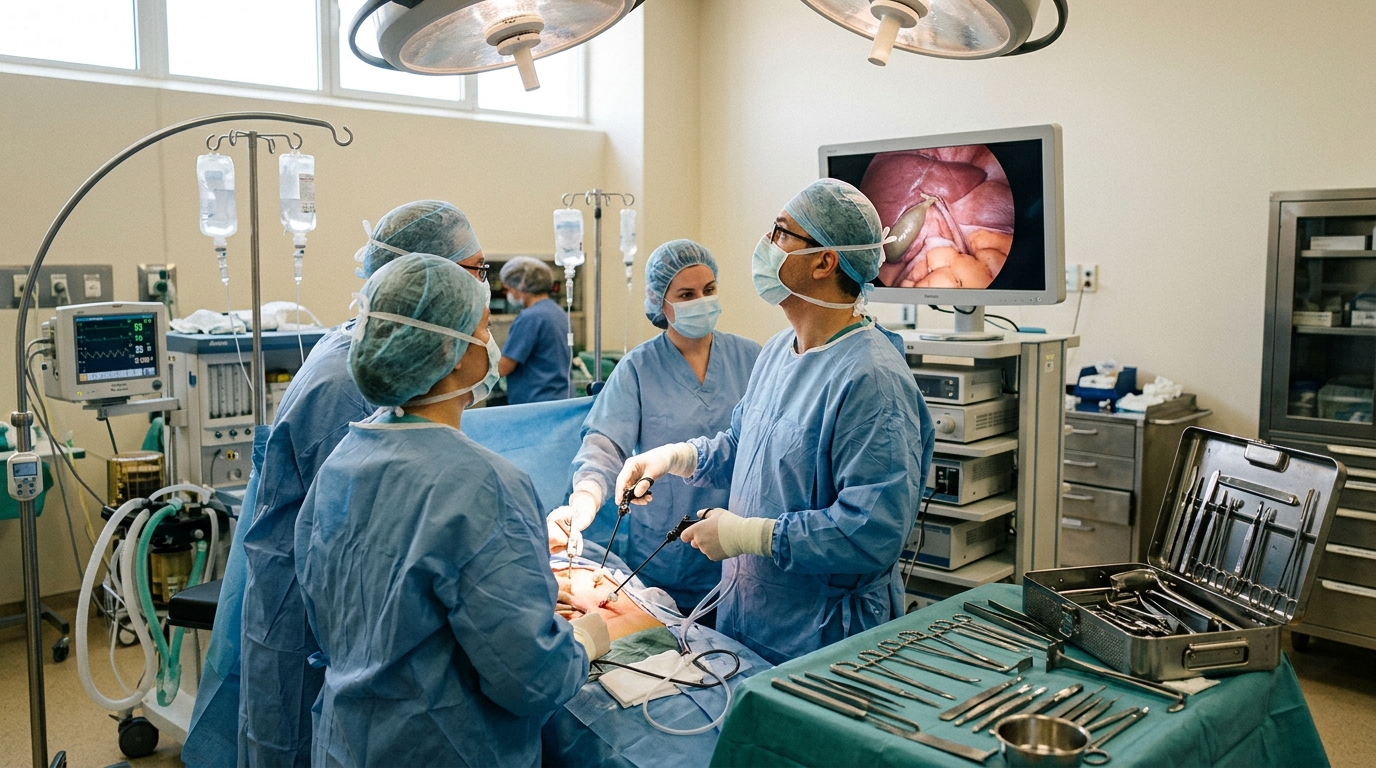
Gallbladder removal (cholecystectomy) is done one of two ways: laparoscopic removal, through several small cuts with a camera, or open removal, through one larger cut below the ribs. Both take out the whole gallbladder, both are done under general anesthesia, and both carry the same core surgical risks. What differs is how much tissue is cut, how long you stay in the hospital, and how many weeks it takes to feel like yourself again.
Often the choice is not fully yours. The approach is decided by your anatomy, your medical history and what the surgeon finds once the operation has started. This guide explains the difference so you can ask better questions before you sign the consent form — your own surgeon and facility set the final protocol.
How the Two Procedures Differ
Invasiveness. Laparoscopic gallbladder removal (keyhole surgery) is done through 3 to 4 small cuts in the belly, with the laparoscope passed through one cut and gas pumped in to expand the space so the surgeon can see (MedlinePlus (NIH/National Library of Medicine), 2025-07-09). Open gallbladder removal (traditional surgery) uses a single larger cut in the upper right part of the belly, below the ribs (MedlinePlus (NIH/National Library of Medicine), 2025-07-09). A laparoscopic operation can become an open one partway through: if the surgeon cannot safely remove the gallbladder with the laparoscope, they switch to a larger cut (MedlinePlus (NIH/National Library of Medicine), 2025-07-09).
Anesthesia type. The same for both: laparoscopic removal is done under general anesthesia, and open removal is also done under general anesthesia (MedlinePlus (NIH/National Library of Medicine), 2025-07-09). Neither is done with local anesthetic or conscious sedation alone. You will be fully asleep and will not feel the operation.
Typical duration. Open removal takes about 1 to 2 hours (MedlinePlus (NIH/National Library of Medicine), 2025-07-09). For the laparoscopic version, that source does not publish a single typical operating time — ask your surgeon for their own estimate, and remember that time in the operating room is longer than time actually operating.
Typical recovery length. Recovery from laparoscopic cholecystectomy takes up to 6 weeks for most people, though many are back to most normal activities in a week or two (MedlinePlus (NIH/National Library of Medicine), 2024-09-30). Recovery from open removal takes 4 to 8 weeks, within which most people can do most of their regular activities (MedlinePlus (NIH/National Library of Medicine), 2024-09-30).
Who typically gets which. Most people have a quicker recovery and fewer problems with laparoscopic surgery than with open surgery, which is why it is the usual first choice (MedlinePlus (NIH/National Library of Medicine), 2025-07-09). Open surgery is used when the laparoscopic approach cannot be done safely — for example unexpected bleeding during a laparoscopic operation, obesity, pancreatitis, third-trimester pregnancy, severe liver problems, past surgeries in the same part of the belly, or severe inflammation of the gallbladder (MedlinePlus (NIH/National Library of Medicine), 2025-07-09).
What Each Procedure Involves
Both operations begin the same way: you are asleep under general anesthesia, given through an IV and a breathing tube managed by the anesthesia team.
The surgeon makes 3 to 4 small cuts in the belly and inserts the laparoscope — a thin tube with a camera — through one of them (MedlinePlus (NIH/National Library of Medicine), 2025-07-09).
Gas is pumped into the belly to expand the space so the organs can be seen and reached (MedlinePlus (NIH/National Library of Medicine), 2025-07-09).
An x-ray called a cholangiogram may be taken, in which dye is injected into the cystic duct so it flows into the common bile duct, to look for stones there (MedlinePlus (NIH/National Library of Medicine), 2025-07-09).
The gallbladder is freed and taken out through one of the small cuts, and the cuts are closed.
If the gallbladder cannot be removed safely this way, the surgeon converts to open surgery with a larger cut (MedlinePlus (NIH/National Library of Medicine), 2025-07-09).
Open gallbladder removal (traditional surgery)
You are put to sleep under general anesthesia (MedlinePlus (NIH/National Library of Medicine), 2025-07-09).
The surgeon makes a cut in the upper right part of the belly, just below the ribs.
The gallbladder is separated from the liver.
The cystic duct and the blood vessels to the gallbladder are cut.
The gallbladder is lifted out and the cut is closed (MedlinePlus (NIH/National Library of Medicine), 2025-07-09).
A drainage tube may be left in the belly to drain bile; if so, it is taken out later by the surgeon (MedlinePlus (NIH/National Library of Medicine), 2024-09-30).
Ask your facility for the exact number of hours before your arrival time that you must stop eating and drinking, and write it down — that cutoff is set by your anesthesia team and facility, not by a general rule. If you are having open surgery, arrange your ride home before the day of surgery: you will not be allowed to drive yourself home from the hospital (MedlinePlus (NIH/National Library of Medicine), 2024-09-30).
Recovery Comparison
Milestone
Laparoscopic removal
Open removal
Going home
Same day or the day after, if there are no complications (MedlinePlus, 2025-07-09)
Hospital stay of 2 or more days (MedlinePlus, 2025-07-09)
Normal energy back
Up to 1 week (MedlinePlus, 2025-07-09)
Several weeks, within the 4 to 8 week recovery window (MedlinePlus, 2025-07-09 and 2024-09-30)
Return to a desk job
About 1 week, depending on pain and energy (MedlinePlus, 2024-09-30)
Inside the 4 to 8 week recovery range; your surgeon sets the date (MedlinePlus, 2024-09-30)
Return to driving
About 1 week, if you are off strong pain medicines and can react quickly in an emergency (MedlinePlus, 2024-09-30)
Not on discharge day — you must arrange another driver; the restart date falls inside the 4 to 8 week range and is set by your surgeon (MedlinePlus, 2024-09-30)
Most normal activities
1 to 2 weeks (MedlinePlus, 2024-09-30)
Within 4 to 8 weeks (MedlinePlus, 2024-09-30)
Full recovery
Up to 6 weeks (MedlinePlus, 2024-09-30)
4 to 8 weeks (MedlinePlus, 2024-09-30)
Follow-up / tube removal
Follow-up visit 1 to 2 weeks after surgery (MedlinePlus, 2024-09-30)
Any bile drainage tube removed by the surgeon in 2 to 4 weeks, with a cholangiogram x-ray first (MedlinePlus, 2024-09-30)
Routine and expected after either operation: soreness around the cuts, tiredness that improves week by week, shoulder or belly discomfort from the gas used in laparoscopic surgery, and a slow return to normal appetite. Pain medicine is part of the plan — your team may use acetaminophen (Tylenol) or a prescription opioid, and which drug, how much and for how long are physician-directed.
Reasons to seek care, not wait: call 911 or go to the ER for chest pain or sudden trouble breathing. Call your surgeon promptly for fever or chills, yellowing of the skin or eyes, worsening rather than improving belly pain, pus or spreading redness at an incision, or repeated vomiting. Do not assume a new symptom is nothing; known risks of both operations include injury to the common bile duct, damage to blood vessels going to the liver, injury to the intestine, inflammation of the pancreas, and general surgical risks such as bleeding, blood clots and infection (MedlinePlus (NIH/National Library of Medicine), 2025-07-09). Confirm your own facility's wound care, lifting limits and call-first instructions with your surgical team, because they vary by surgeon and hospital.
Questions to Ask Your Doctor
"Based on my history and imaging, am I a candidate for the laparoscopic approach, or are you planning open surgery from the start?"
"What would make you convert from laparoscopic to open surgery in the middle of my operation, and how likely is that in my case?"
"If I end up with the open operation, how many days should I expect to be in the hospital, and who will drive me home?"
"Will you be doing a cholangiogram x-ray during my surgery, and what happens if you find a stone in the common bile duct?"
"Do you expect to leave a drainage tube in, and if so, when would it come out?"
"Exactly how many hours before my arrival time do I stop eating and drinking, and which of my regular medicines do I take that morning?"
"Which pain medicine will I go home with, and how long should I be off it before I drive again?"
"My job involves lifting and standing — for my procedure, what week can I realistically go back?"
"Which symptoms do you want me to call you about, and which ones should send me straight to the ER?"
"When is my follow-up visit booked for, and who do I call after hours?"
"Where should I check what this operation will cost me — your billing office, my insurer, or both?"
Frequently asked questions
If laparoscopic surgery recovers faster, why would anyone have the open operation?
Open surgery is not a worse version of the same choice; it is the safe option when the keyhole approach is not. MedlinePlus (NIH/National Library of Medicine, 2025-07-09) lists reasons including obesity, pancreatitis, third-trimester pregnancy, severe liver problems, previous surgery in the same area of the belly, severe gallbladder inflammation, and unexpected bleeding during a laparoscopic operation. Your surgeon weighs those factors against the quicker recovery most people have with the laparoscopic approach.
Will I be awake for either procedure, or sedated rather than fully asleep?
Neither operation is done with local anesthetic or moderate (conscious) sedation alone. Both laparoscopic and open gallbladder removal are done under general anesthesia, so you are fully asleep (MedlinePlus (NIH/National Library of Medicine), 2025-07-09). Your anesthesia team will go over the specific plan, your airway and your medical history with you before the day.
I consented to laparoscopic surgery and woke up with a larger cut. What happened?
Surgeons routinely ask you to consent to both approaches, because the decision can only be made once they can see inside. If the gallbladder cannot be removed safely with the laparoscope, the surgeon switches to open surgery with a larger cut (MedlinePlus (NIH/National Library of Medicine), 2025-07-09). Your recovery timeline then follows the open-surgery range of 4 to 8 weeks rather than the laparoscopic one (MedlinePlus, 2024-09-30), so ask for updated work and driving advice before you leave the hospital.
Does the number of weeks off work depend on my job or just on the procedure?
Both. For laparoscopic surgery, MedlinePlus (NIH/National Library of Medicine, 2024-09-30) describes a return to a desk job at about a week, depending on pain and energy levels — that figure is for desk work, not lifting or physical labor. Full healing still takes up to 6 weeks after laparoscopic surgery and 4 to 8 weeks after open surgery, so ask your surgeon for a date tied to your actual job duties.
Priya covers food as it's actually eaten, not as it appears in meal-plan fantasies. She writes with a skepticism toward quick fixes and a soft spot for the boring, repeatable choices that add up over years.