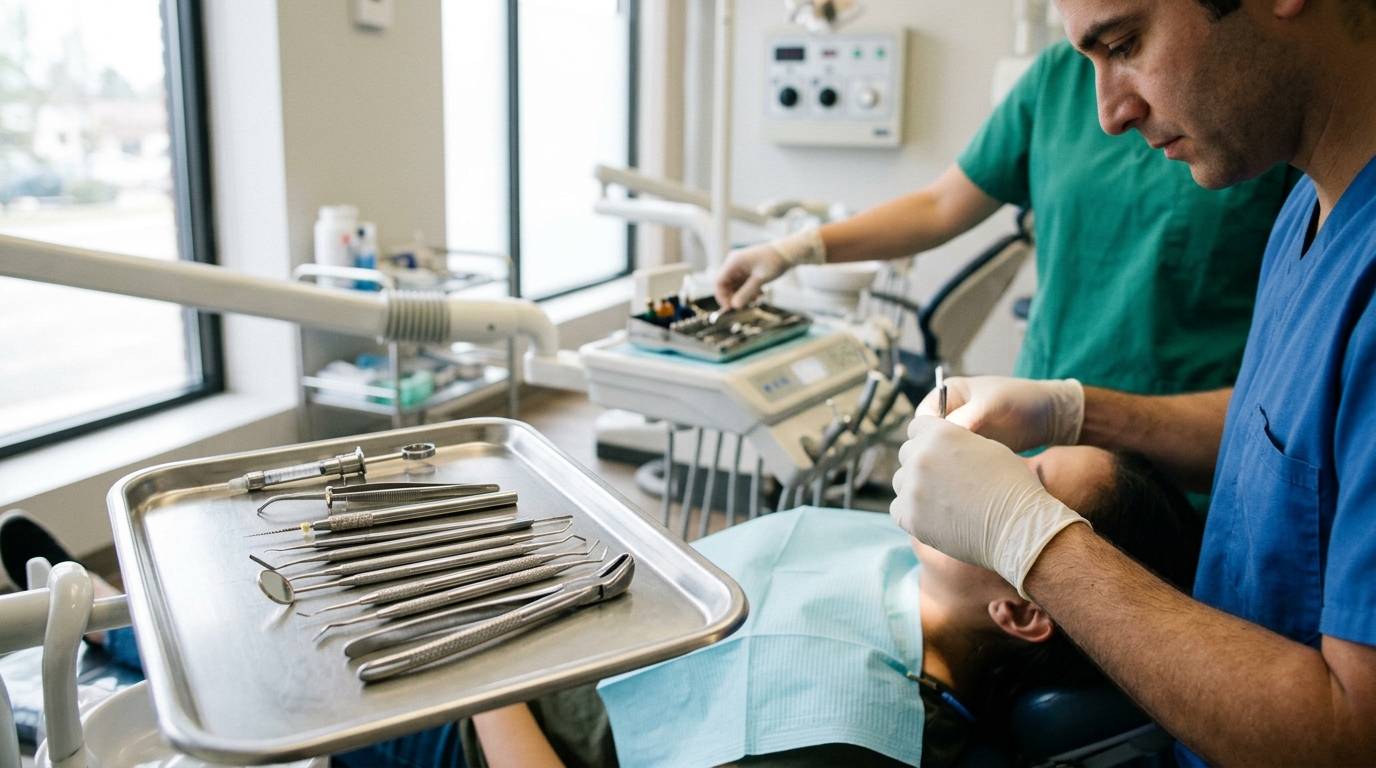
Root canal treatment (cleaning out and sealing the inside of a tooth) and tooth extraction (having the tooth pulled) are two answers to the same problem: a tooth whose nerve is infected, cracked or badly decayed. One keeps the tooth in your jaw; the other takes it out and leaves a space you will later decide whether to fill. The choice usually turns on how much sound tooth is left, the state of the bone and gum around it, and what your dentist or endodontist sees on the X-ray.
This guide compares the two on invasiveness, the type of numbing used, how long each appointment takes, and how long recovery runs — then gives you questions to put to your own dentist. Protocols differ between offices, so confirm every instruction with the team doing your procedure.
How the Two Procedures Differ
Both procedures address the same underlying problem, but they differ on every practical dimension you will feel.
Invasiveness. Root canal treatment (cleaning out and sealing the inside of a tooth) is done through a small opening made in the top of the tooth; the roots stay anchored in your jaw, and the tooth is later rebuilt with a crown or other restoration (American Association of Endodontists, undated). Tooth extraction (having the tooth pulled) removes the entire tooth: the dentist loosens and removes it, cleans and disinfects the socket, may place a bone graft and may place stitches (Cleveland Clinic, undated). It also leaves a gap, so replacement options become a separate conversation.
Anesthesia type. For a root canal, most endodontists choose local anesthesia, numbing only the area being treated, and whether sedation is offered varies by endodontist (American Association of Endodontists, undated). For an extraction, the dentist gives local anesthesia, plus sedation medications if you choose them (Cleveland Clinic, undated); a dentist may raise sedation options specifically for dental anxiety or added comfort (Cleveland Clinic, undated). Sedation levels are usually described as moderate (conscious) sedation or, less often and generally in a hospital or surgical setting, general anesthesia — ask which one is being proposed for you by name.
Typical duration. Most root canals are completed in one to two appointments, each lasting roughly 90 minutes (American Association of Endodontists, undated), and a separate visit with your general dentist follows for the crown. Removing one tooth usually takes between 30 and 60 minutes, longer if several teeth come out at once (Cleveland Clinic, undated).
Typical recovery length. After a root canal the tooth may feel slightly sore for a few days, and in most cases symptoms improve within three to five days (American Association of Endodontists, undated). After an extraction, most people return to work or school within a day or two and to routine activities within 48 to 72 hours, while jobs involving heavy lifting may need a few more days (Cleveland Clinic, undated); for a large tooth such as a molar, the jaw itself can take up to four months to heal fully (Cleveland Clinic, undated).
Who each tends to suit. Removal is discussed when there is severe decay, gum disease or dental trauma, and it reduces harmful bacteria and can ease dental pain almost immediately (Cleveland Clinic, undated). Root canal treatment is offered when enough sound tooth and supporting bone remain to rebuild on; studies cited by the American Association of Endodontists put its success rate above 90%, and with proper restoration and good oral hygiene a treated tooth can last a lifetime. Your own candidacy depends on the X-ray and exam, not on averages.
What Each Procedure Involves
Root canal treatment (cleaning out and sealing the inside of a tooth)
Examination and X-ray, then a local anesthetic injection to numb the tooth and surrounding area, then placement of a dental dam — a small sheet that isolates the tooth and keeps it dry (American Association of Endodontists, undated).
A small opening is made in the top of the tooth so the pulp chamber and canals can be cleaned and shaped.
The canals are filled with gutta-percha, a biocompatible rubber-like material, along with cement, and a temporary filling is placed (American Association of Endodontists, undated).
After the final visit with the endodontist, you return to your general dentist to have a crown or other restoration placed, which protects the tooth and restores full function (American Association of Endodontists, undated).
Tooth extraction (having the tooth pulled)
Local anesthesia is given, plus sedation medications if you and your dentist have chosen them — most often moderate (conscious) sedation (Cleveland Clinic, undated).
The tooth is loosened and removed.
The socket is cleaned and disinfected.
A bone graft may be placed to preserve the shape of the jaw, and stitches may be placed (Cleveland Clinic, undated).
You bite on gauze to help a clot form, and your dentist explains aftercare and any replacement options.
Preparing. If your procedure uses local anesthetic only, you can normally eat and drink as usual beforehand. If moderate (conscious) sedation or general anesthesia is planned, offices commonly instruct nothing to eat for 8 hours before and arranging a driver for the whole day — confirm the exact fasting window and escort rule with your own office, because it varies by facility and by the medication used. Bring a current list of your medications to the consultation.
Recovery Comparison
Milestone
Root canal
Tooth extraction
Driving yourself home
Same day, immediately after the appointment, because most root canals use local anesthesia and patients stay awake (American Association of Endodontists, undated)
Same day if local anesthesia only; if sedation is used, plan on someone else driving for the remaining 12–24 hours of that day
Return to work or school
Same day to the next day, around the 90-minute appointment (American Association of Endodontists, undated)
Within 1–2 days for most people (Cleveland Clinic, undated)
Physically demanding or heavy-lifting work
Same day to 2–3 days, while the tooth is still tender
1–2 days plus a few more days — roughly 3–7 days total (Cleveland Clinic, undated)
Routine daily activities
Same day to 2–3 days
Within 48–72 hours (Cleveland Clinic, undated)
Soreness and swelling settle
Slight soreness for a few days, improving within 3–5 days in the majority of cases (American Association of Endodontists, undated)
Bleeding, bruising and swelling should go away within 1 week (Cleveland Clinic, undated)
Treatment fully finished
1–2 visits of about 90 minutes each, plus a separate crown visit with your general dentist (American Association of Endodontists, undated)
Up to 4 months for the jaw to heal fully after a large tooth such as a molar (Cleveland Clinic, undated)
Routine and expected. Mild soreness around a root-canal-treated tooth for a few days; after an extraction, some bleeding, bruising and swelling in the first week. Your dentist may direct over-the-counter pain relievers such as ibuprofen (Advil, Motrin) or acetaminophen (Tylenol) — dosing and timing are physician-directed, so follow the instructions you are given rather than general advice.
Reasons to call your dentist for follow-up. Severe pain 1 to 3 days after a tooth is pulled, especially pain radiating to the ear, eye, temple or neck on the same side, can signal dry socket (MedlinePlus, National Library of Medicine, undated). Reported risk factors include not caring for the mouth properly after the extraction, a past history of dry socket, drinking through a straw, and excessive rinsing or spitting (MedlinePlus, undated). Other recognised extraction complications include delayed healing, infection, maxillary sinus damage and nerve injury (Cleveland Clinic, undated). Pain that worsens rather than settles after a root canal also warrants a call. No dental symptom is automatically harmless — if something feels wrong, report it.
Call 911 or go to the emergency room for difficulty breathing or swallowing, swelling spreading into the neck or closing the eye, or bleeding that soaks through gauze and will not stop with steady pressure. These are different from the expected soreness and swelling above. Ask your own care team for their after-hours number and their specific threshold for coming in.
Questions to Ask Your Doctor
Take these to the consultation and write the answers down.
"Looking at my X-ray, is there enough sound tooth and bone left for a root canal, or are you recommending extraction because of decay, gum disease or trauma?"
"If we save this tooth, what restoration will it need afterwards, and which appointment places the crown?"
"Will this be local anesthetic only, or are you recommending moderate (conscious) sedation — and if so, how many hours before should I stop eating, and do I need someone to drive me?"
"How many appointments will this take, and roughly how long is each one?"
"How many days off should I plan, given the kind of work I do?"
"If the root canal doesn't settle, what is the next step — retreatment or extraction — and how would we decide?"
"If we extract, will you place a bone graft or stitches, and what are my options for replacing the tooth later?"
"What level of pain or swelling should make me call you, and what should send me straight to an emergency room?"
"Which pain reliever do you want me using, and at what timing?"
"Who do I call after hours, and on weekends?"
"Can your office give me a written estimate so I can confirm what my insurer covers before I schedule?" — cost and coverage must be confirmed with your provider and insurer; no guide can tell you what you will pay.
Confirm every instruction above — fasting, driving, aftercare, follow-up timing — with the dentist or endodontist performing your procedure, since protocols differ by office and by clinician.
Frequently asked questions
If I have a root canal and it doesn't work, can I still pull the tooth later?
Extraction generally remains available if a treated tooth continues to cause problems, and your dentist may also raise retreatment of the root canal as an option. The American Association of Endodontists cites studies showing a success rate above 90% for root canal treatment, but that figure describes a population, not your individual tooth. Ask directly how your clinician would decide between retreatment and removal, and what signs would prompt that conversation.
An extraction is quicker — doesn't that mean it's the easier recovery?
The appointment is shorter, at 30 to 60 minutes for one tooth compared with roughly 90 minutes per root canal visit (Cleveland Clinic and the American Association of Endodontists, both undated), but the healing is longer. After a root canal most symptoms improve within three to five days, while after an extraction routine activities resume within 48 to 72 hours and a molar socket's jawbone can take up to four months to heal fully. Compare the recovery, not the chair time.
Will I be asleep for either procedure?
Usually not. Most endodontists choose local anesthesia for root canals, numbing only the treated area, and whether sedation is offered varies by endodontist (American Association of Endodontists, undated). For extractions, local anesthesia is standard and sedation medications may be added if you choose them, which a dentist may suggest for dental anxiety or added comfort (Cleveland Clinic, undated). Ask which specific option — local alone, moderate (conscious) sedation, or general anesthesia — is being planned for you.
Why does a root canal need another appointment afterwards?
The endodontist seals the canals with gutta-percha and cement and places a temporary filling, which is not built to take years of chewing. You then return to your general dentist for a crown or other restoration that protects the tooth and returns it to full function (American Association of Endodontists, undated). An extraction has no equivalent step, though replacing the missing tooth is a separate decision you may want to discuss at the same visit.
Cleveland ClinicTooth Extraction: When You Should Have One & What To Expect
Written by
Oyelaran Fitzgerald
Oyelaran focuses on movement for people who don't think of themselves as 'fitness people.' His pieces favor sustainable routines over dramatic transformations, and he's allergic to before-and-after photos.