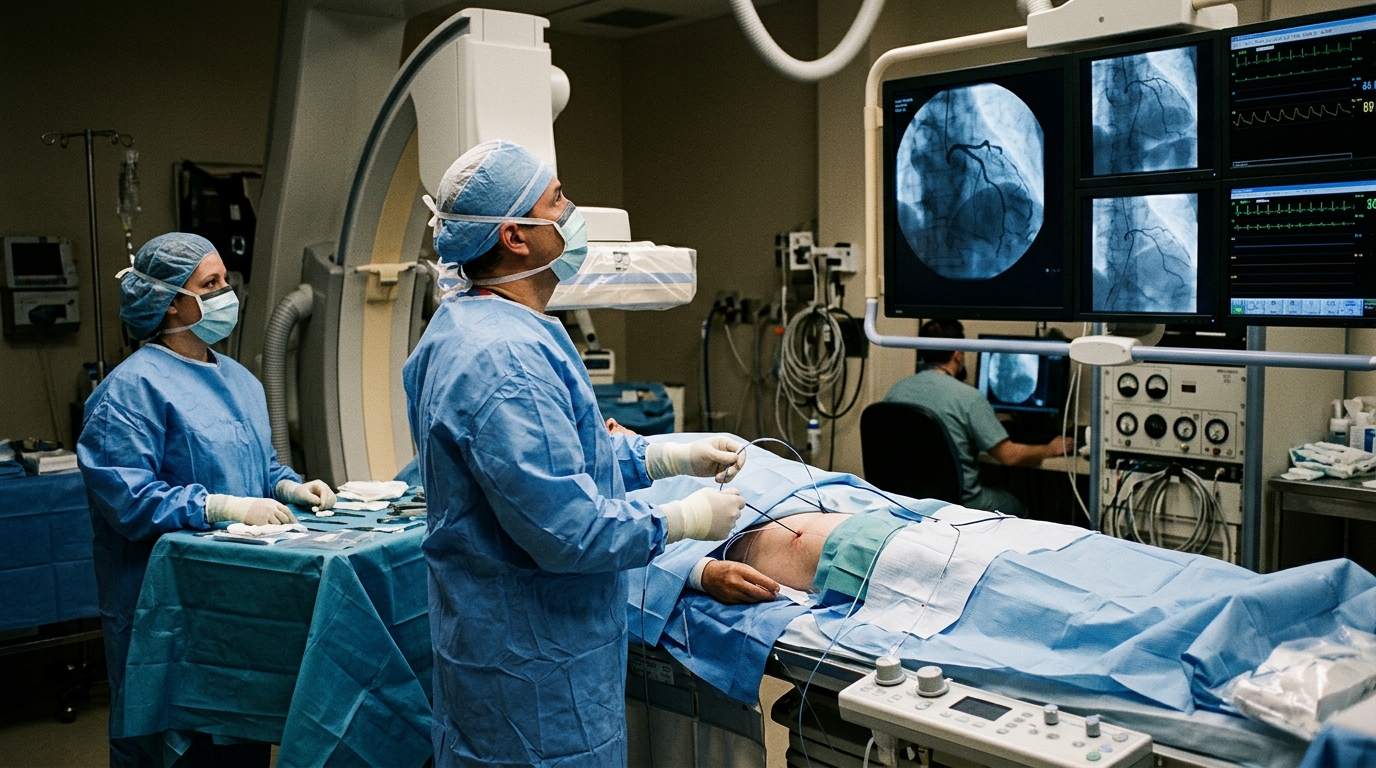
Cardiac catheterization (a heart cath) is a test in which a thin tube is threaded through a blood vessel in your wrist or groin up to your heart, usually with contrast dye, so your cardiologist can see how your heart muscle, valves and coronary arteries are working. Most people are awake, lightly sedated, and home within hours.
This guide covers why it is ordered, what to arrange in the days before, the order of events in the cath lab, what recovery looks like, and the symptoms that mean you should call for help rather than wait. Protocols differ by hospital, by physician and by your other medical conditions, so confirm every specific with your own care team.
Why This Procedure Is Done
Cardiac catheterization (heart cath) is used to look directly at the inside of the heart and its arteries when less invasive testing has not answered the question. The American Heart Association (Circulation journal) describes it as most often performed after a history and physical exam and noninvasive cardiac testing — an ECG (electrocardiogram, a tracing of the heart's electrical activity), an echocardiogram (an ultrasound of the heart) or a stress test (exercise or medication test) — to evaluate symptoms such as chest pain, shortness of breath, fatigue, dizziness or palpitations.
The conditions it is most commonly used to diagnose or assess, according to the National Heart, Lung, and Blood Institute, include coronary heart disease (narrowed heart arteries), heart attack, heart valve disease such as aortic stenosis (a stiff, narrowed valve) or mitral regurgitation (a leaking valve), cardiomyopathy (disease of the heart muscle), pulmonary hypertension (high pressure in the lung arteries) and arrhythmia (irregular heart rhythm).
Those earlier noninvasive tests are the usual first step, and noninvasive imaging of the coronary arteries is sometimes used before a cath as well. Whether one of them is reasonable in your case depends on your symptoms, your age, your kidney function and your other conditions — ask your cardiologist why a catheterization is being recommended now rather than another test.
How to Prepare
7 days before: Call the ordering cardiologist's office and ask, item by item, which of your medicines to hold and for how long. The American Heart Association (Circulation journal) notes that certain oral anticoagulants — for example warfarin (Coumadin) or dabigatran (Pradaxa) — and injectable anticlotting drugs should be held before the procedure as directed by the managing clinician. Holding, timing and restarting are physician-directed decisions; do not change any dose on your own.
7 days before: Tell the office, yes or no, whether you have ever reacted to contrast dye (X-ray dye) or iodine, and whether you have kidney disease or diabetes.
3 days before: Arrange a licensed adult driver to take you home, and arrange for someone to stay with you the first night. Sedation rules out driving yourself.
The day before: Ask the facility for your exact fasting start time. MedlinePlus (NIH) states that in most cases you should not eat or drink for a set period before the test, though your cardiologist may give different directions — get the hour in writing.
The morning of: Bring a written list of every prescription, over-the-counter drug and supplement you take, plus your ID. Leave rings and jewelry at home.
Confirm with your own team: Prep protocols vary by hospital and physician. Before you fast or hold anything, confirm the fasting window, the medication list and your arrival time with the cath lab or the ordering provider.
What Happens During the Procedure
Check-in and prep. You change into a gown, and staff place monitors on your chest and a blood pressure cuff. An IV is placed in a vein in your arm, according to the National Heart, Lung, and Blood Institute, to give medicine during the procedure.
Site preparation. The access site — most often the wrist (radial) or the upper thigh/groin (femoral), and sometimes the neck or under the collarbone — is cleaned and shaved if needed.
Sedation and numbing. MedlinePlus (NIH) describes a mild sedative given beforehand to help you relax, with a local anesthetic (numbing medicine) at the insertion site; you will most likely be awake during the procedure. Some labs use moderate (conscious) sedation; general anesthesia is unusual for a straightforward adult diagnostic cath. Ask which your lab plans to use.
Catheter insertion. A small tube is placed in the artery and a thin catheter is guided up to the heart using X-ray. You should not feel the catheter moving inside the vessel; pressure at the access site is common, and contrast dye can cause a brief warm flush.
Pictures and measurements. Dye is injected to outline the coronary arteries, and pressures inside the heart chambers may be recorded. You may be asked to hold your breath or cough briefly.
Finishing. The catheter is removed and the site is closed with firm pressure, a compression device or a closure device. The American Heart Association (Circulation journal) notes that after a radial (wrist) procedure, a band on the wrist maintains pressure and wrist movement is restricted for several hours.
Typical duration: about 45 minutes for the procedure itself (American Heart Association, Circulation journal). MedlinePlus (NIH) notes a left heart catheterization may last from less than an hour to several hours, depending on what is found and whether treatment is added.
Recovery and Aftercare
Routine and expected
Several hours of monitored bed rest or restricted movement. After radial access, wrist movement is restricted for several hours while the compression band is in place (American Heart Association, Circulation journal). After femoral (groin) access, you will usually lie flat for a period set by your physician.
A small bruise and tenderness at the access site are normal, according to the National Heart, Lung, and Blood Institute.
Grogginess, mild nausea or a dry mouth from sedation for the rest of the day.
If angioplasty (balloon opening of an artery, often with a stent) is done during the cath, MedlinePlus (NIH) states people can generally walk around within a short time afterward and that complete recovery takes about a week or less. A diagnostic cath without treatment is generally the shorter end of that.
MedlinePlus (NIH) advises keeping the insertion area dry for a specified period and avoiding sexual activity for a specified period — ask your doctor for your exact number of days, as it depends on the access site and what was done.
Not expected — contact your care team
A lump at the site that is growing, or pain that is worsening rather than easing.
Fever, spreading redness or drainage from the site.
The hand or leg below the site turning cold, pale or numb.
Returning chest discomfort, new breathlessness or fainting.
Discharge timing, driving, lifting limits and return-to-work advice vary by facility and by access site. Confirm your own restrictions in writing before you leave.
Risks and When to Call Your Doctor
The American Heart Association (heart.org) describes cardiac cath as usually very safe, with major complications very rare, and the American Heart Association (Circulation journal) calls it a common diagnostic procedure in the United States with minimal risk. MedlinePlus (NIH) presents the risk of serious complications from coronary angiography as a range rather than a single fixed figure. Your own risk depends on your age, kidney function, heart function and other conditions — ask your cardiologist to put a number to your situation.
Common, usually minor
Bleeding or hematoma (a collection of blood) at the puncture site — the most common risk (American Heart Association, Circulation journal).
Bruising and tenderness at the site.
Reaction to contrast dye, and nausea or vomiting from sedation medicines (American Heart Association, heart.org).
Rarer, reported complications
The National Heart, Lung, and Blood Institute lists allergic reaction to dye, irregular heart rhythm, blood clots, collapsed lung (pneumothorax), damage to blood vessels, heart valves or the heart, low blood pressure, infection, need for blood transfusion and need for emergency surgery such as coronary artery bypass graft. MedlinePlus (NIH) also lists cardiac tamponade (fluid compressing the heart), injury to a heart artery, stroke and heart attack. The American Heart Association (Circulation journal) describes heart attack, stroke, need for emergent cardiac surgery and death as extremely rare.
Call 911 or go to the ER now
Bleeding from the access site that cannot be stopped with firm pressure — the National Heart, Lung, and Blood Institute says to seek help immediately, as this may signal a serious problem.
Chest pain or pressure, severe shortness of breath, fainting.
Sudden weakness or numbness on one side, slurred speech or facial drooping.
Call your cardiologist the same day for fever, a growing lump, spreading redness, drainage, or a hand or foot that is cold, pale or numb.
Frequently asked questions
Will I be asleep during the cath?
Most likely not. MedlinePlus (NIH) describes a mild sedative to help you relax plus a local numbing medicine at the insertion site, with the patient most likely awake. Some labs use moderate (conscious) sedation, which leaves you drowsy and often with patchy memory of the procedure. Ask your lab which approach they use and who will be monitoring your sedation.
What happens if they find a blockage while I'm on the table?
In many hospitals, the cardiologist can treat a significant blockage during the same session with angioplasty and a stent, which is why the appointment may run longer than the roughly 45 minutes the American Heart Association (Circulation journal) cites for the procedure itself. Your consent form usually covers this possibility in advance. Ask before the day whether your physician treats findings immediately or brings you back, and what that would mean for your recovery and medicines.
Can I drive myself home?
No. Sedation medicines affect judgment and reaction time for the rest of the day, so arrange a licensed adult driver and, ideally, someone to stay with you overnight. Confirm your facility's specific discharge rule when you book, since some require the driver to be present in the building before they will start the procedure.
When can I shower, and when can I go back to work or sex?
MedlinePlus (NIH) advises keeping the insertion area dry for a specified period and avoiding sexual activity for a specified period, and says to ask your doctor when it is okay to resume. The exact days depend on whether the wrist or groin was used and whether a stent was placed. Get those numbers written on your discharge sheet before you leave.
How much will this cost, and will insurance cover it?
Cost and coverage vary by hospital, by physician group and by your plan, and nobody writing generally can tell you your figure. Call your insurer with the procedure name and the facility's billing codes, and ask the hospital's financial counselor for a written estimate. Do this before the date if you can, since facility and physician fees are often billed separately.
Will I feel the catheter inside my chest?
Blood vessels do not have the kind of nerve endings that would let you feel a catheter moving through them. Standard consent discussions describe pressure at the puncture site while the tube is placed, and a brief warm or flushed sensation when contrast dye is injected. Tell the team right away if you feel chest discomfort, which they want to know about during the procedure, not afterward.
Priya covers food as it's actually eaten, not as it appears in meal-plan fantasies. She writes with a skepticism toward quick fixes and a soft spot for the boring, repeatable choices that add up over years.